
In a single-stage screw compressor, air is drawn in and compressed from atmospheric pressure to the final delivery pressure in one pass through a single rotor set. It works, and for many applications it works adequately. But physics imposes a cost. Compressing air in a single step generates significant heat — and that heat represents energy that goes into warming the air rather than raising its pressure. The hotter the compression process, the less efficient the overall conversion of motor power into useful compressed air.
A two-stage screw air compressor splits that process. Air enters the first stage and is compressed to an intermediate pressure — roughly the geometric mean of the atmospheric and final pressures. It then passes through an intercooler, where that compression heat is removed before the air enters the second stage for the final pressure rise. Cooling between stages means the second-stage rotor is working on denser, cooler air, which requires less energy to compress further.
The result is a mechanically more efficient compression process. The specific power — kilowatts consumed per unit of air delivered — is lower for a two-stage unit than a single-stage unit producing equivalent output. That gap widens as delivery pressure increases, which is why two-stage configurations are particularly common in applications demanding 10 bar and above.
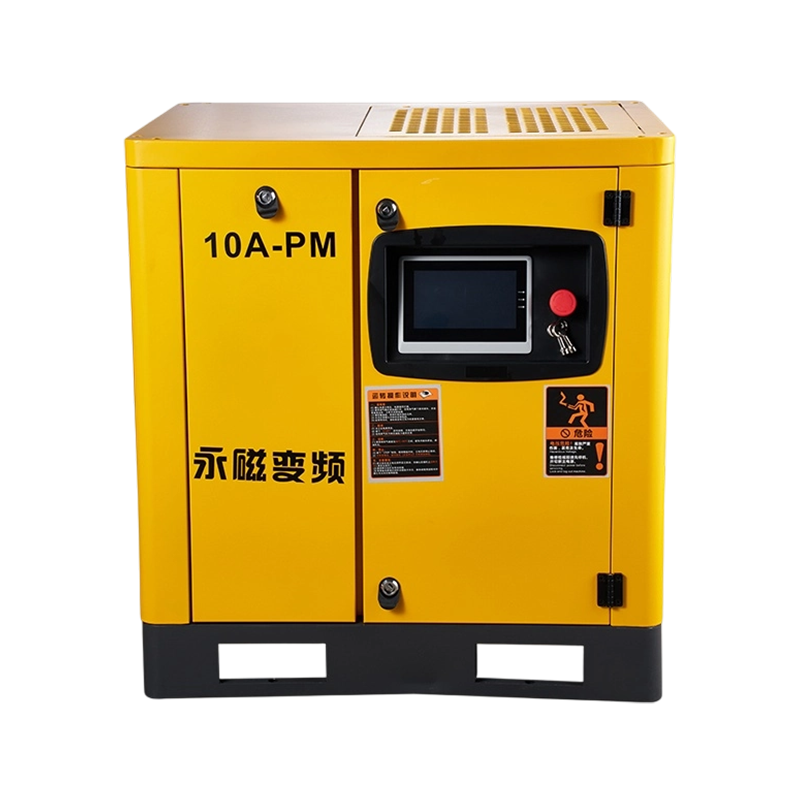
Two-stage compression addresses how efficiently the machine compresses air. Variable frequency drive — VFD, also called variable speed drive — addresses a different problem: how well the compressor matches its output to what the system actually needs at any given moment.
A fixed-speed compressor runs at one motor speed regardless of demand. When the plant is at full production and air consumption is high, that's fine. When demand drops — during shift changes, partial-load periods, or seasonal variation in production — the fixed-speed unit keeps spinning at full rate. It either vents the excess air or idles in an inefficient load/unload cycle. Either way, energy is being consumed without useful work being done.
A variable frequency drive adjusts motor speed continuously to track actual demand. When demand falls, the motor slows. When it rises, the motor accelerates. The compressor delivers roughly what the system needs rather than a fixed volume the system then has to manage around. In facilities with variable air demand — which describes the operating reality of a wide range of manufacturing and processing environments — that matching capability translates directly into measurable reductions in electricity consumption.
Two-stage compression and variable frequency drive are each useful independently. Together, they address different inefficiencies in the same machine and their benefits compound rather than simply add.
The two-stage rotor configuration improves the thermodynamic efficiency of compression itself — each unit of air costs less energy to produce. The VFD then ensures that only as many units of air as the system actually needs are produced at any given time. One technology reduces the cost per unit. The other reduces unnecessary units. The combination delivers a level of system efficiency that neither approach achieves on its own.
This is particularly relevant for operations where compressed air demand is both high in absolute terms and variable across the production day. A large automotive assembly plant, a food and beverage processing facility, a textile manufacturer with multiple shifts and varying machine utilisation — these are environments where both dimensions of efficiency matter simultaneously and the case for a two-stage variable frequency screw air compressor is straightforward to make on technical grounds.
 View More
 View More
 View More
 View More
 View More
 View More
 +86-576-8262 1313
 +86-576-8262 1216
 +86-13867656789
 +86-13867656789
Xiayun Village, Hengjie Town, Luqiao District, Taizhou City Zhejiang Province, China

Copyright © Zhejiang Zhilun Mechanical & Electrical Co., Ltd. All Rights Reserved.
Air Compressor Factory

 English
 русский
 Français
 Español
 Português
