 English
 русский
 Français
 Español
 Português
Cooperate Hand in Hand · Create Value Together
Welcome to Consult and Visit, We Are Dedicated to Serving You!
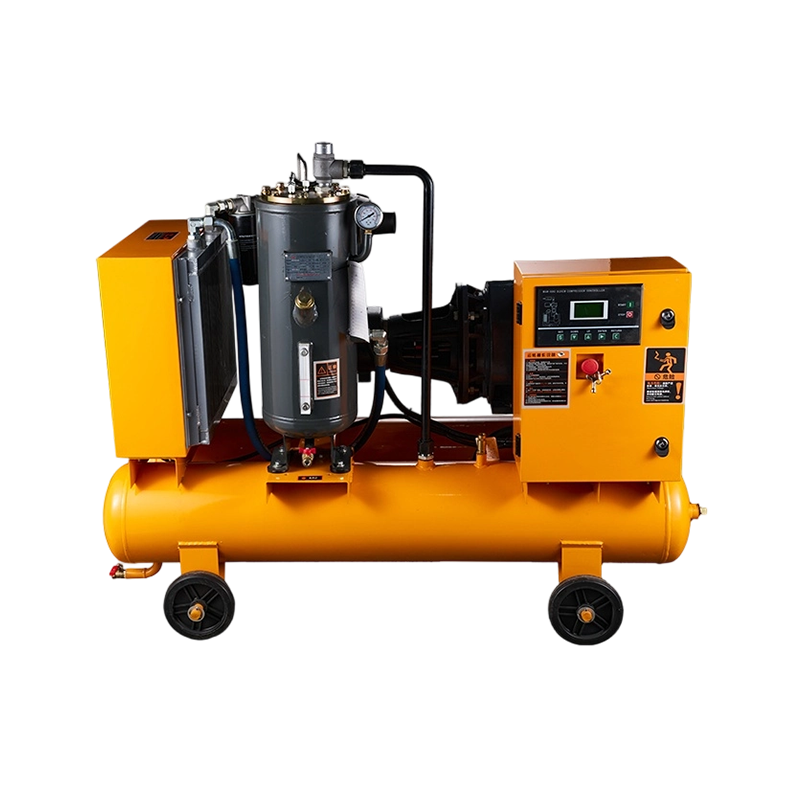
The integrated screw compressor, driven by a fixed frequency, lacks variable frequency speed control. Structurally, it integrates the screw compressor and post-processing equipment (such as filters) onto a common base or frame, forming a unified compressed air station.
① One-stop air supply: Connection and commissioning are completed before delivery; simply connect the pipeline upon arrival at the site to produce qualified compressed air. Installation is very convenient.
② Space saving: Modular and compact design saves significant installation space compared to purchasing individual components.
③ Economical and practical: For scenarios requiring clean, dry air but with stable operating conditions and limited budgets, the initial investment is lower than variable frequency models.
④ Centralized maintenance and management: With major components integrated, daily inspections and maintenance points are relatively centralized. Suitable for small and medium-sized manufacturing industries (such as pneumatic tools and packaging), automotive repair (painting), food processing (packaging, mixing), and other fields with basic requirements for air source quality and relatively stable operating conditions.


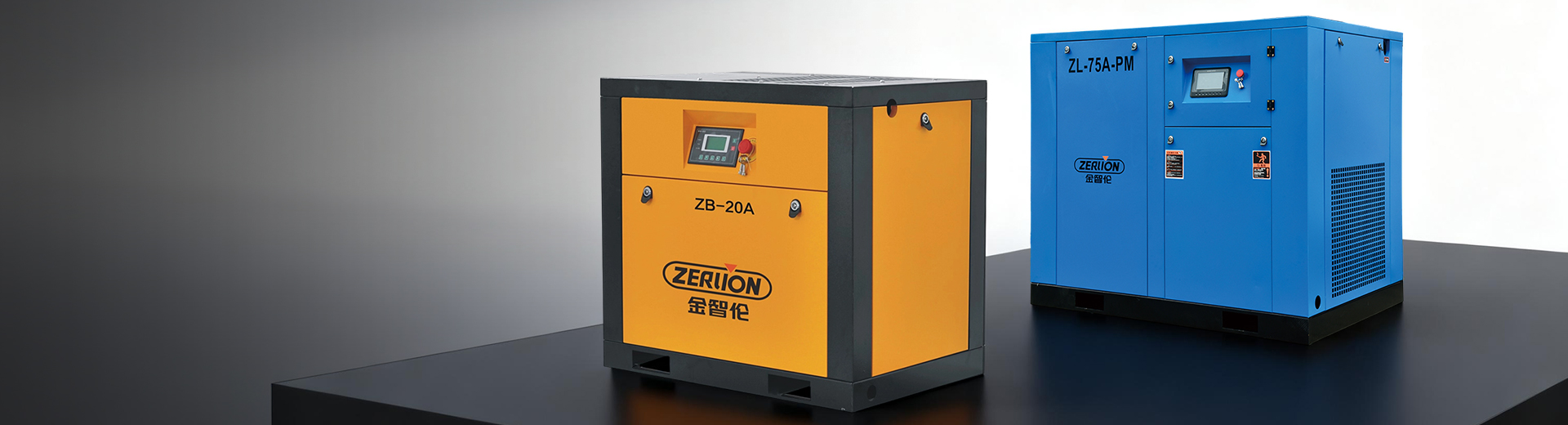
Manufacturing plants, workshops, and construction sites rely on steady compressed air for tools, machinery, and processes. An Air Compressor Factory works as a specialized partner that designs and bui...
READ MOREAt what temperature does the airend "evaporate" moisture? A stable airend temperature within the proper range is the first line of defense for safe operation of a compressed air system. Many maintena...
READ MORECompressed air systems waste a surprising amount of energy just idling between demand spikes. A factory floor might need full airflow for ten minutes, then almost nothing for the next twenty, and a co...
READ MOREDemand Rises For Low-Pressure Air Systems Compressed air is used across many industrial processes, but not every application requires high-pressure air. Some production equipment needs a steady flow o...
READ MORERotary screw machines form a steady stream of compressed air through continuous volume reduction rather than intermittent strokes. In belt-driven screw compressors the electric motor sits separate fro...
READ MOREManufacturing plants running compressed air systems around the clock have been paying closer attention to how their equipment behaves under partial load, and that shift in attention has pushed the per...
READ MOREThe essence of a modular screw compressor lies in deconstructing an entire compressed air system into several standardized functional modules. Each module can operate independently or be combined in parallel with other modules to form a supply system with a larger air output capacity. This design philosophy transcends the limitations inherent in traditional single-unit configurations. During the initial construction phase, enterprises are not required to make a one-time investment in a large-scale compressor; instead, they can begin with smaller modules and gradually increase the number of modules as production capacity expands. This approach enables a phased, incremental expansion of air supply capabilities, thereby effectively controlling staged investment costs and enhancing capital efficiency.
Against the backdrop of continuous advancements in industrial automation, the demand for compressed air systems among enterprises has shifted away from rigid, static configurations toward a need for flexible supply capabilities that can dynamically adapt to changes in production scale. The Ordinary Modular Screw Compressor is a product category that has matured precisely in response to this demand. Distinguished by its modular architecture, flexible deployment options, and ease of maintenance, it has found widespread application across diverse sectors, including manufacturing, chemicals, building materials, and electric power.
The essence of a modular screw compressor lies in deconstructing an entire compressed air system into several standardized functional modules. Each module can operate independently or be combined in parallel with other modules to form a supply system with a larger air output capacity.
This design philosophy transcends the limitations inherent in traditional single-unit configurations. During the initial construction phase, enterprises are not required to make a one-time investment in a large-scale compressor; instead, they can begin with smaller modules and gradually increase the number of modules as production capacity expands. This approach enables a phased, incremental expansion of air supply capabilities, thereby effectively controlling staged investment costs and enhancing capital efficiency.
The Conventional Modular Screw Compressor represents a category within the modular product series that boasts a long history of development and a high degree of market maturity.
Structurally, conventional modular models build upon established screw compression technologies, integrating the compressor host, motor, cooling system, and control unit within a standard-sized frame module. The various modules interconnect via standardized piping interfaces and electrical connection ports; consequently, on-site installation requires no complex, custom-engineered piping work, thereby significantly shortening the overall project deployment cycle. Several key advantages of traditional modular compressor models are worth noting:
Thanks to their mature and stable technological framework, traditional modular screw compressors are particularly well-suited for industrial users who demand high continuity in their air supply and possess a certain level of expertise in equipment management.
The Mechanical Modular Screw Compressor focuses on enhancing the practical engineering utility of modular design at the level of mechanical structure. It represents a specialized product category tailored specifically for heavy industry and complex operating environments.
In terms of structural design, mechanical modular models primarily address the following engineering challenges:
| Single Module Power (kW) | Single Module Air Delivery (m³/min) | Working Pressure (MPa) | Max. Number of Parallel Modules | Applicable Scenarios |
| 15 | 1.8-2.4 | 0.7 – 0.84 | 4 | Light Industry, Electronics Assembly |
| 22 | 2.8-3.6 | 0.7 – 1.0 | 4 | Food Processing, Printing |
| 37 | 4.5-6.2 | 0.7 – 1.0 | 6 | Machinery Manufacturing, Textiles |
| 55 | 7.0-9.5 | 0.7 – 1.25 | 6 | Automotive Parts, Building Materials |
| 75 | 9.5-13.0 | 0.7 – 1.25 | 8 | Chemical Auxiliaries, Heavy Industry |
| 110 | 14.0-19.0 | 0.7 – 1.25 | 8 | Large-scale Production Lines, Metallurgy |
The table above provides general industry reference data; specific configurations should be comprehensively planned based on on-site piping pressure drop, peak air demand, and available installation space.
When purchasing modular screw compressors, the following aspects warrant particular attention:
 +86-576-8262 1313
 +86-576-8262 1216
 +86-13867656789
 +86-13867656789
Xiayun Village, Hengjie Town, Luqiao District, Taizhou City Zhejiang Province, China

Copyright © Zhejiang Zhilun Mechanical & Electrical Co., Ltd. All Rights Reserved.
Custom Mechanical Modular Screw Air Compressor