 English
 русский
 Français
 Español
 Português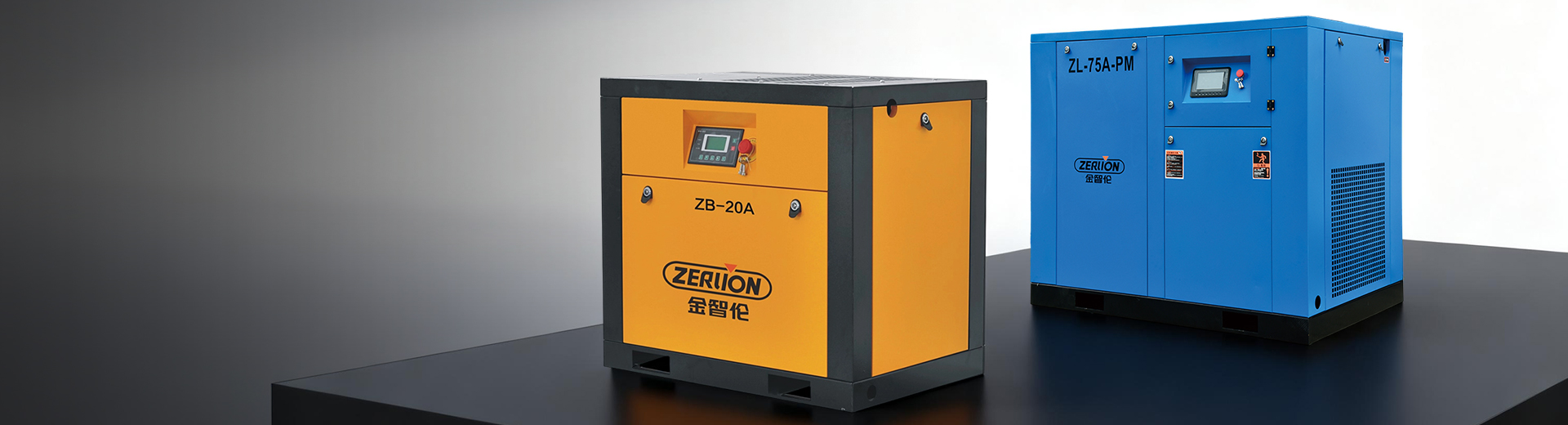
Cooperate Hand in Hand · Create Value Together
Welcome to Consult and Visit, We Are Dedicated to Serving You!
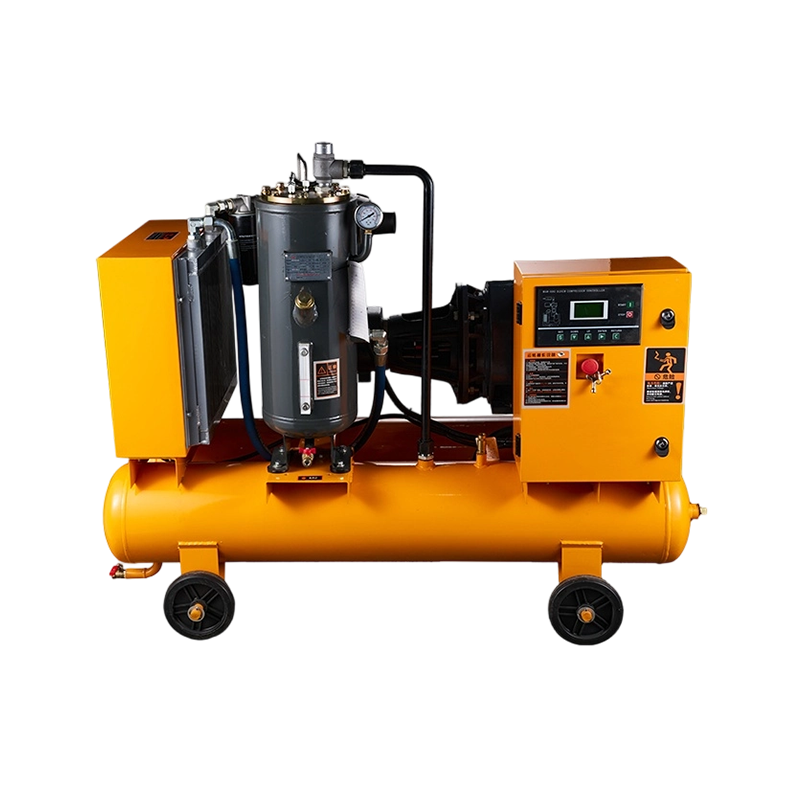
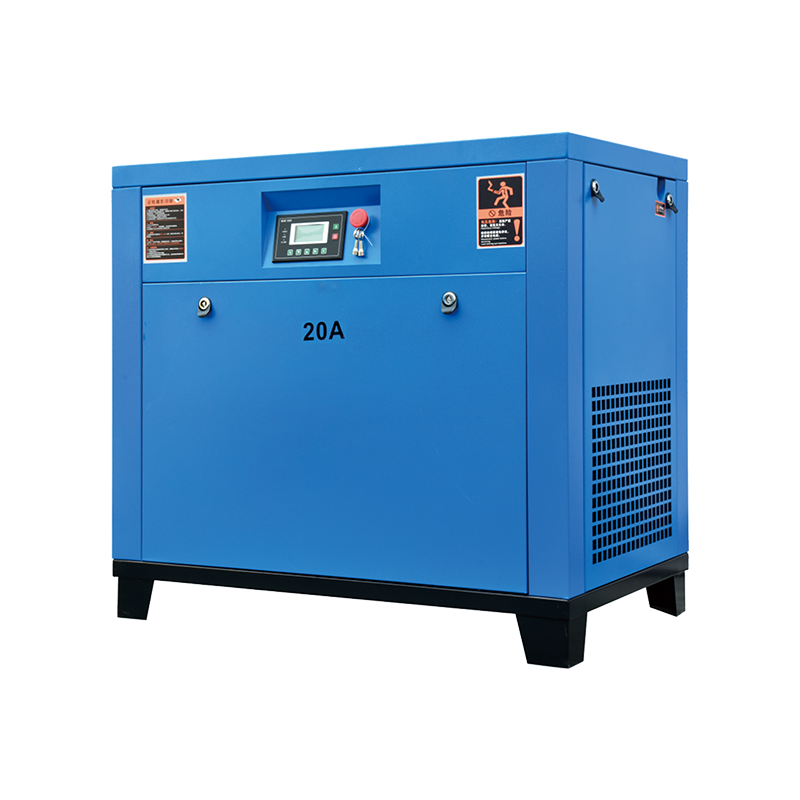
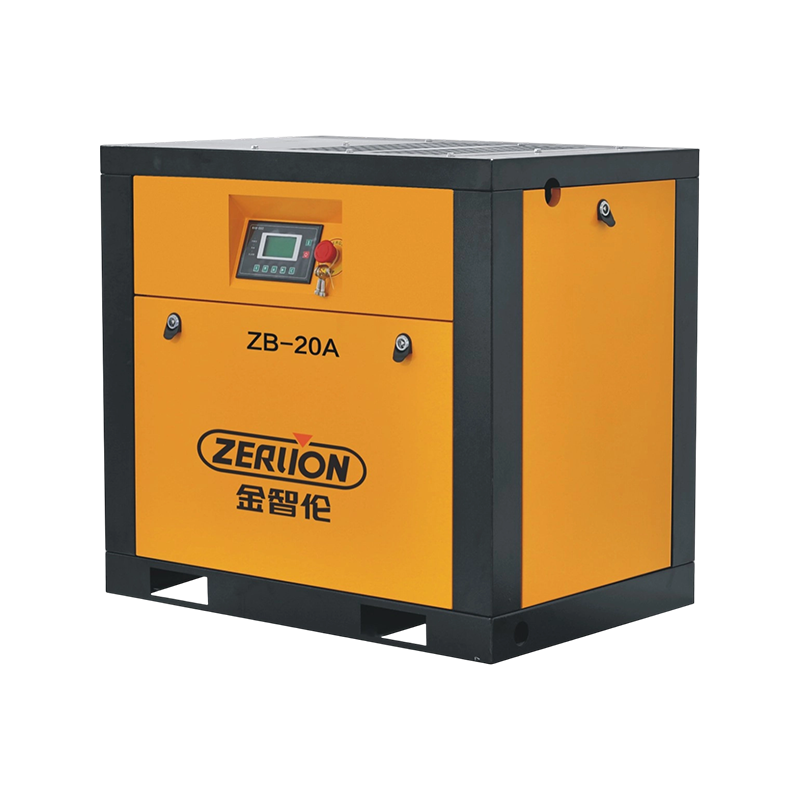
① As a widely used air compressor in the industrial field, the industrial frequency screw compressor remains a reliable choice in many scenarios due to its robust structure, stable operation, and economic practicality.
② Because of its relatively simple structure and mature technology, the initial purchase cost of an industrial frequency screw compressor is usually lower than that of a variable frequency model of the same specifications. Furthermore, its widespread availability makes subsequent maintenance easier.
③ Industrial frequency screw compressors are suitable for operating conditions with stable air demand and long-term continuous operation. For example, they perform well in scenarios such as shotcrete support, concrete spraying, and pneumatic tool driving. In industries requiring large amounts of compressed air, such as manufacturing, chemical, power, and mining/metallurgy, industrial frequency screw compressors are also widely used due to their high load adaptability.
Manufacturing plants, workshops, and construction sites rely on steady compressed air for tools, machinery, and processes. An Air Compressor Factory works as a specialized partner that designs and bui...
READ MOREAt what temperature does the airend "evaporate" moisture? A stable airend temperature within the proper range is the first line of defense for safe operation of a compressed air system. Many maintena...
READ MORECompressed air systems waste a surprising amount of energy just idling between demand spikes. A factory floor might need full airflow for ten minutes, then almost nothing for the next twenty, and a co...
READ MOREDemand Rises For Low-Pressure Air Systems Compressed air is used across many industrial processes, but not every application requires high-pressure air. Some production equipment needs a steady flow o...
READ MORERotary screw machines form a steady stream of compressed air through continuous volume reduction rather than intermittent strokes. In belt-driven screw compressors the electric motor sits separate fro...
READ MOREManufacturing plants running compressed air systems around the clock have been paying closer attention to how their equipment behaves under partial load, and that shift in attention has pushed the per...
READ MOREStandard screw compressors—characterized by their simple structure, stable operation, and convenient maintenance—have long remained a staple on the procurement lists of small and medium-sized enterprises. Compared to variable-frequency models, standard screw compressors—thanks to their lower initial investment costs and mature, reliable technology—continue to serve as indispensable core power equipment across a wide range of manufacturing environments.
The core components of a screw compressor consist of a pair of interlocking male and female rotors. An electric motor drives the rotors to rotate; gas is drawn in through the intake port, and as the volume within the rotor grooves progressively decreases, the gas is continuously compressed before finally being discharged through the outlet at a predetermined pressure.
The entire compression process is continuous and smooth, involving no reciprocating parts; consequently, vibration and noise levels are low, and the operational lifespan significantly exceeds that of traditional piston-type compressors. Standard screw compressors typically employ a fixed-frequency drive system, operating continuously at a constant rotational speed. With their mature structural design and low failure rate, they are ideally suited for industrial environments characterized by stable air demand and continuous production operations.
Among the various drive mechanisms utilized in standard screw compressors, the Direct-Drive Screw Air Compressor has emerged in recent years as one of the most widely adopted and mainstream solutions.
The term "direct-drive" refers to a configuration in which the motor's output shaft is coupled directly to the rotors of the compressor's air-end, thereby eliminating the intermediate transmission stages—such as belts or gears—found in traditional systems. This design yields significant improvements in performance:
A "Standard Screw Compressor" refers to a general-purpose screw compressor product that complies with international or industry standards and specifications, and has undergone a systematic, standardized design process. The core value of standardized models is reflected across three key levels:
The following table provides a reference for the core parameters of common standard screw compressors across various power ranges:
| Power (kW) | Air Displacement (m³/min) | Working Pressure (MPa) | Drive Type | Applicable Scenarios |
| 7.5 | 0.8 – 1.0 | 0.7 – 0.8 | Direct Drive / Belt Drive | Small Workshops, Repair Stations |
| 15 | 1.6 – 2.0 | 0.7 – 0.8 | Direct Drive | Light Industry, Food Processing |
| 37 | 4.0 – 5.5 | 0.7 – 1.0 | Direct Drive | Mechanical Manufacturing, Textiles |
| 75 | 8.5 – 11.0 | 0.7 – 1.0 | Direct Drive | Automotive Painting, Auxiliary Metallurgy |
| 132 | 15.0 – 20.0 | 0.7 – 1.25 | Direct Drive | Large-scale Assembly Lines, Chemical Industry |
| 250 | 28.0 – 38.0 | 0.7 – 1.25 | Direct Drive | Steel Industry, Large Manufacturing Bases |
Note: Actual parameters may vary slightly depending on the specific brand and model. When selecting a unit, it is recommended to conduct a comprehensive assessment that takes into account the peak air demand at the site as well as pressure drop within the piping network.
During the selection phase, it is recommended to focus on the following four dimensions:
 +86-576-8262 1313
 +86-576-8262 1216
 +86-13867656789
 +86-13867656789
Xiayun Village, Hengjie Town, Luqiao District, Taizhou City Zhejiang Province, China

Copyright © Zhejiang Zhilun Mechanical & Electrical Co., Ltd. All Rights Reserved.
Fixed-speed Screw Air Compressor Suppliers