
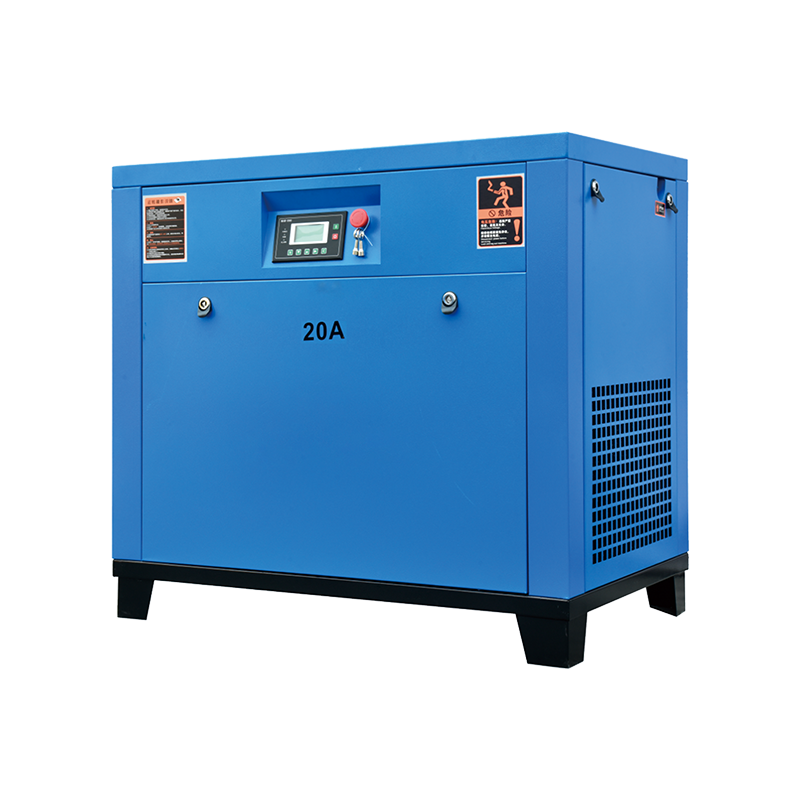
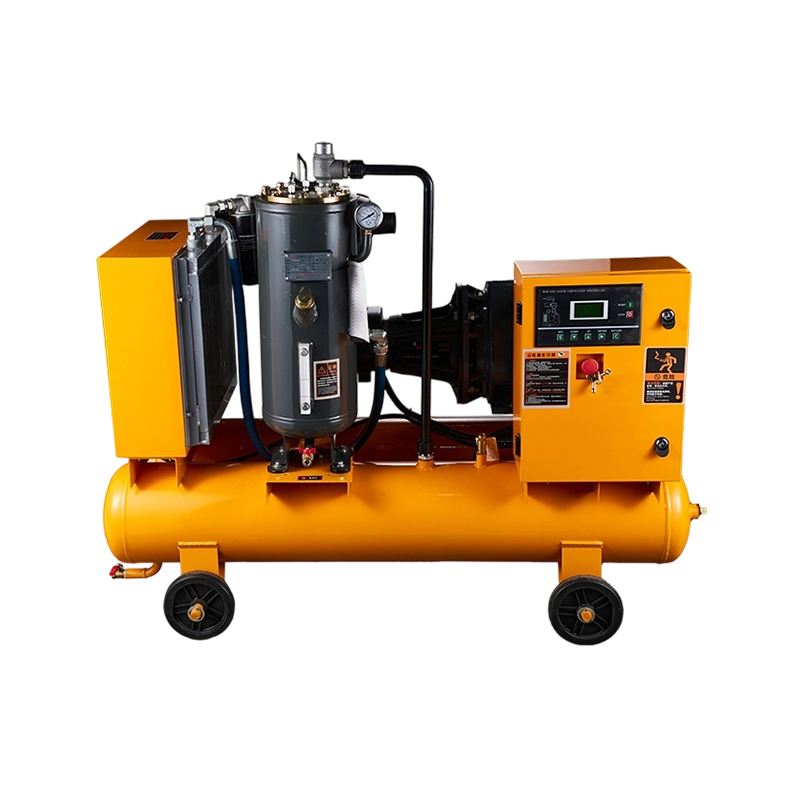
A two-stage screw air compressor delivers compressed air through sequential compression steps that improve overall efficiency in industrial settings. Plant engineers and facility managers examine its pressure ratio, intercooling approach, and continuous-duty capability when matching equipment to production demands. The two-stage screw air compressor divides the compression process into two rotors sets, allowing heat removal between stages and supporting stable output under sustained loads.
In a two-stage screw air compressor the first rotor pair raises air pressure to an intermediate level. The partially compressed air then passes through an intercooler that reduces its temperature before entering the second rotor pair. This second stage completes the compression to the final discharge pressure. By splitting the work, the machine limits the temperature rise that would occur in a single continuous compression path.
Intercooling improves volumetric efficiency because cooler air occupies less volume and requires less energy for further compression. The two-stage screw air compressor therefore maintains consistent flow rates even when operating near its design pressure. Oil-injected or oil-free configurations both benefit from this staged approach, depending on the purity requirements of the downstream process.
Male and female rotors mesh closely within each stage to trap and move air along the compression path. Precise clearances minimize internal leakage while allowing continuous rotation. The two-stage screw air compressor arranges the stages either in a single housing or in separate modules linked by piping and the intercooler. Discharge ports and check valves direct the flow so pressure builds steadily without reverse flow during shutdown.
Bearing supports and shaft seals keep the rotors aligned under the radial and axial forces generated during operation. Vibration remains low because the rotary motion is continuous rather than reciprocating. These mechanical traits allow the two-stage screw air compressor to run for extended periods with predictable acoustic and thermal behavior.
The two-stage screw air compressor connects to existing distribution networks through standard discharge flanges and aftercoolers. Moisture separators and filters placed downstream remove condensate and particulates before the air reaches points of use. Control systems monitor discharge pressure, motor current, and stage temperatures, adjusting operation to keep the machine within safe thermal and mechanical limits.
Multiple units can operate in parallel, with sequencing logic that starts additional compressors only when demand exceeds the capacity of the running machines. This arrangement keeps the two-stage screw air compressor fleet responsive while avoiding unnecessary energy use during low-demand periods.
Housing materials and internal coatings resist the combination of heat, pressure, and residual moisture present in compressed-air systems. Access panels allow inspection of rotors, bearings, and coolers without complete disassembly. The two-stage screw air compressor is typically mounted on a skid that includes the motor, coupling, and basic instrumentation, simplifying installation on a prepared foundation.
Cooling options include air-cooled or water-cooled heat exchangers for the intercooler and aftercooler. Selection depends on site conditions and available utilities. In either case the goal remains the same: remove heat effectively so the compression stages operate within their intended temperature bands.
Assembly lines, fabrication shops, and process plants rely on steady compressed air for actuators, spray systems, and material handling. The two-stage screw air compressor supplies this air with a pressure profile that remains stable under varying loads. Its ability to deliver higher pressures without excessive temperature rise makes it suitable for applications that include both low-pressure and elevated-pressure users on the same network.
Noise levels stay moderate because the rotary design avoids the pulsation common in reciprocating machines. Acoustic enclosures further reduce sound transmission when the equipment is located near occupied work areas. These characteristics allow the two-stage screw air compressor to operate within typical factory layouts without creating additional operational constraints.
 View More
 View More
 View More
 View More
 View More
 View More
 +86-576-8262 1313
 +86-576-8262 1216
 +86-13867656789
 +86-13867656789
Xiayun Village, Hengjie Town, Luqiao District, Taizhou City Zhejiang Province, China

Copyright © Zhejiang Zhilun Mechanical & Electrical Co., Ltd. All Rights Reserved.
Air Compressor Factory

 English
 русский
 Français
 Español
 Português

