
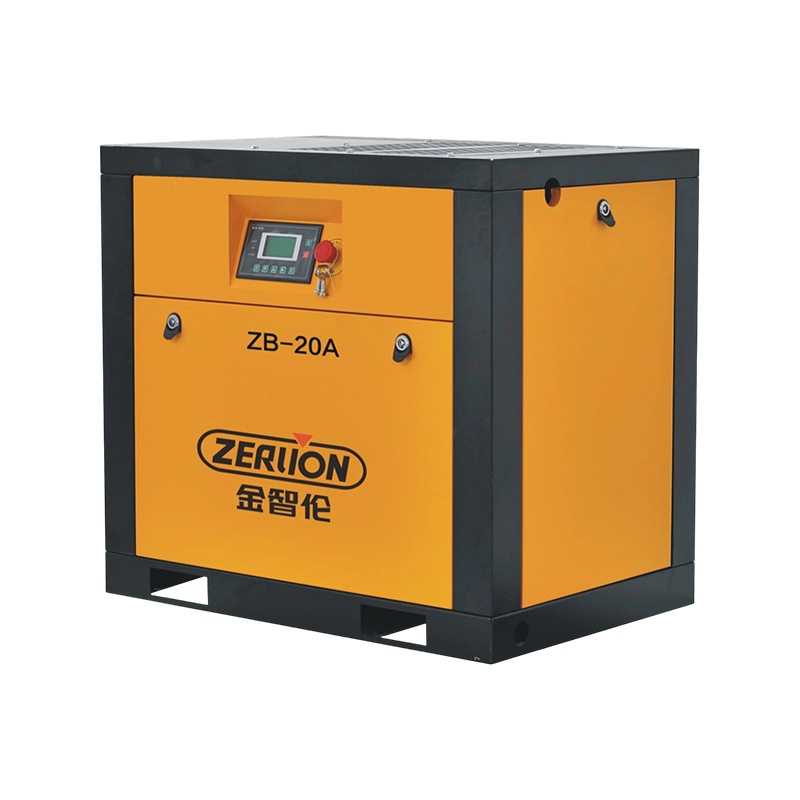
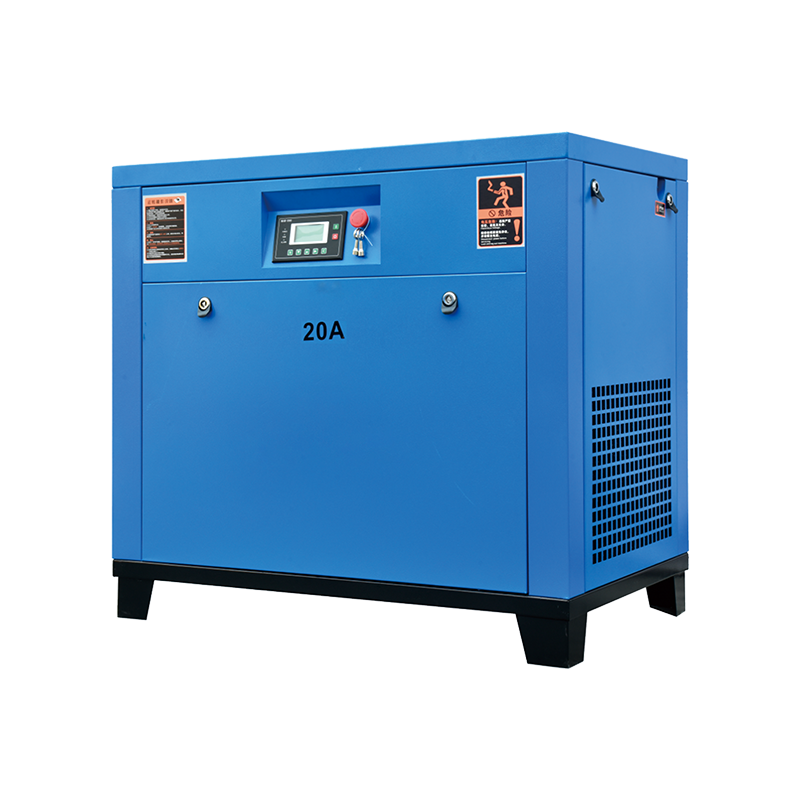
Compressed air plays an important role in manufacturing, workshops, packaging lines, and industrial processing. A Fix speed screw air compressor (Belt-driven) is designed to provide a steady supply of compressed air through a rotary screw compression system powered by an electric motor and belt transmission.
Unlike a variable-speed unit that adjusts motor speed according to air demand, a fixed-speed compressor operates at a set speed when running. This arrangement can suit facilities with relatively consistent compressed air requirements, such as production lines using pneumatic tools, automated actuators, and air-operated equipment.
The belt-driven structure connects the motor to the compressor air end through pulleys and a drive belt. This configuration influences power transmission, equipment layout, and the way the compressor is integrated into an industrial air system.
Fixed-speed compressors are generally suited to applications where compressed air demand remains reasonably stable during operating periods. When the machine runs, the motor operates at its designated speed rather than continuously adjusting its rotation to follow changing demand.
Depending on the control system, compressor output may be managed through load and unload operation. When air demand reaches the configured operating range, the compressor loads and produces compressed air. When demand decreases, the system may unload the compressor according to its control settings.
This operating arrangement makes it important to understand the air consumption of connected equipment. Pneumatic production tools, filling machinery, automated assembly stations, and material-handling systems may have different air consumption patterns.
Selecting a Fix speed screw air compressor (Belt-driven) therefore involves evaluating the actual air demand, required pressure, and operating schedule instead of relying on motor power alone.
Compressed air supports a wide range of industrial tasks. In metalworking facilities, it can power pneumatic tools, cleaning equipment, and selected automation devices. Packaging operations use compressed air for actuators, product handling, and certain filling or sealing processes.
In woodworking workshops, pneumatic nailers and other air-powered tools may require a dependable air supply during production. General assembly plants can use compressed air for clamping, positioning, and material movement.
A Fix speed screw air compressor (Belt-driven) may also serve manufacturing sites where several machines operate at similar times and demand follows a relatively predictable pattern. The suitability of the equipment depends on the combined air consumption of these machines and the pressure required at their connection points.
Industrial users should also account for pressure losses in piping, air treatment equipment, and distribution connections when determining the compressor's required operating conditions.
Choosing a compressor involves more than comparing motor ratings. Air delivery, working pressure, motor power, transmission design, and control configuration all influence whether a unit fits a specific production process.
The compressor's rated air delivery should correspond to the expected consumption of connected equipment, with suitable consideration for variations in demand. If the selected capacity does not match the application, the system may struggle to maintain the required pressure or may operate through frequent load changes.
The belt-driven arrangement also affects equipment dimensions and internal component positioning. Buyers can review the compressor's installation footprint, electrical requirements, air outlet connection, and integration with existing compressed air piping.
For a Fix speed screw air compressor (Belt-driven), these specifications provide a clearer basis for matching equipment to factory operations and production schedules.
 View More
 View More
 View More
 View More
 View More
 View More
 +86-576-8262 1313
 +86-576-8262 1216
 +86-13867656789
 +86-13867656789
Xiayun Village, Hengjie Town, Luqiao District, Taizhou City Zhejiang Province, China

Copyright © Zhejiang Zhilun Mechanical & Electrical Co., Ltd. All Rights Reserved.
Air Compressor Factory
 English
 русский
 Français
 Español
 Português

