
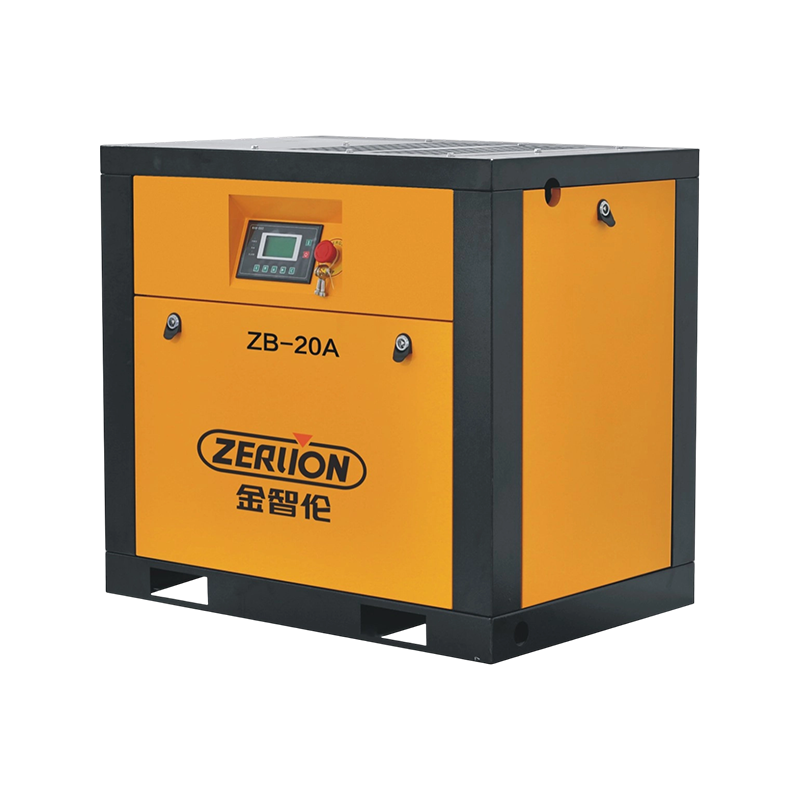
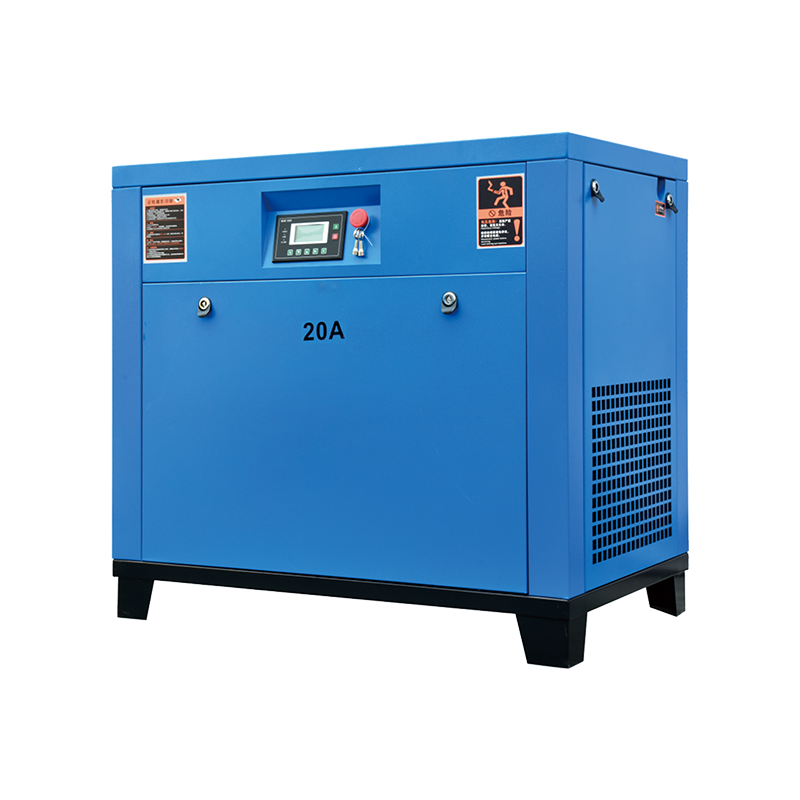
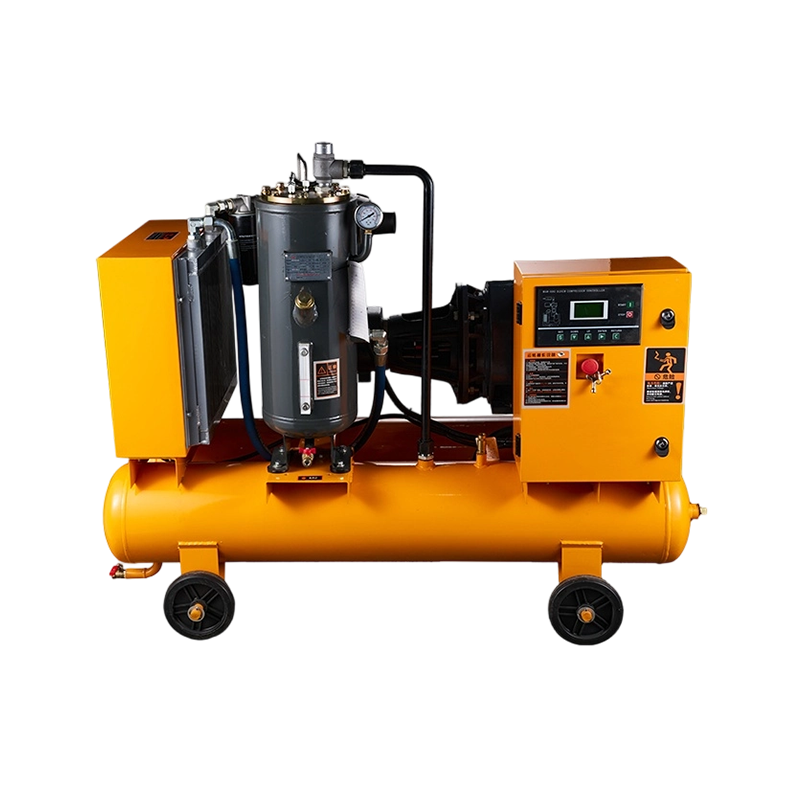
General Purpose Screw Air Compressors have long held a significant share of the market. While they lack complex variable-frequency control systems or specialized integrated structures, their mature design, stable operation, ease of maintenance, and relatively controllable acquisition costs make them the preferred choice for numerous small-to-medium-sized factories and applications requiring a steady air supply.
The Operating Principle of Standard Screw Air Compressors
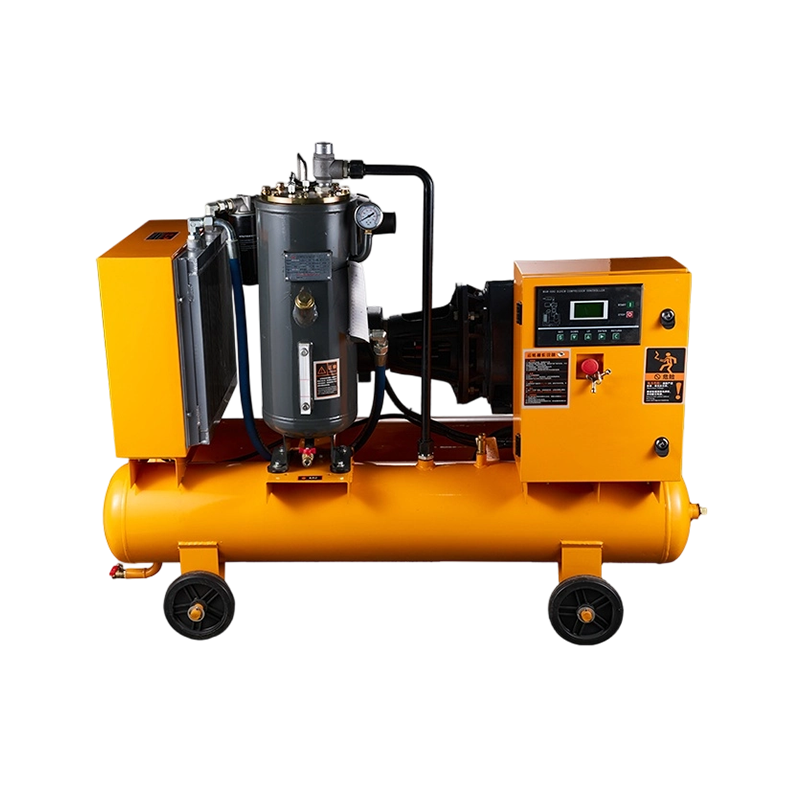
The core component of a screw air compressor is a pair of interlocking male and female rotors. After gas is drawn in through the intake port, the rotation of the rotors causes the volume within the rotor cavities to progressively decrease; the gas is continuously compressed and is ultimately discharged through the outlet port at a predetermined pressure.
Standard screw air compressors are driven by fixed-frequency motors. The motor drives the screw air-end at a constant speed to produce a steady output of compressed air. When the system air pressure reaches a preset upper limit, the compressor enters an "unloaded" state, allowing the motor to idle while maintaining system pressure; when the pressure drops to the lower limit, the unit "reloads" to resume air supply. This entire process is automated via a pressure switch or controller; the operational logic is simple and intuitive, requiring minimal technical expertise from the operator.
Regarding lubrication, standard screw air compressors typically employ an oil-injection method. The lubricating oil serves a triple function: cooling the rotors, sealing the internal clearances, and minimizing wear. Following an oil-gas separation process, the residual oil content in the compressed air can be controlled to a very low level, thereby satisfying the air quality requirements of most industrial applications.
Ideal Applications for Standard Screw Air Compressors
Not all operating conditions necessitate high-end variable-frequency (VFD) or permanent-magnet drive equipment. In the following scenarios, a standard screw air compressor often proves to be the more pragmatic choice:
For backup or emergency air supply configurations, standard screw air compressors offer a simple structure and highly interchangeable spare parts, making them both reliable and economical choices as a backup air source for production lines.
Key Parameters for Selecting a Standard Screw Air Compressor
During the selection phase, the following parameters serve as the fundamental basis for determining whether a specific unit is suitable for your operating conditions:
Key Comparison Dimensions for Selecting a Standard Screw Air Compressor
| Comparison Dimension | Selection Guidelines |
| Displacement | Determined based on total air consumption requirements plus a safety margin coefficient. |
| Working Pressure | Selected by balancing the pressure requirements of air-consuming equipment against pressure losses within the piping system. |
| Motor Power | Must be matched to the available electrical distribution capacity. |
| Cooling Method | Air-cooled units are suitable for standard environments; water-cooled units are ideal for high-temperature or high-power scenarios. |
| Transmission Method | Options include belt-driven or direct-drive systems; each is suited to specific operating conditions. |
| Lubrication Type | Oil-injected lubrication is the prevailing standard configuration. |
| Control Method | Typically utilizes pressure switches or intelligent controllers. |
| Installation Conditions | Requires adequate space for ventilation and heat dissipation, a load-bearing foundation, and compatible piping interfaces. |
Key Points for Routine Maintenance: Ensuring Continuous and Stable Operation
Maintenance for standard screw air compressors follows a relatively predictable schedule. By mastering the following key points, you can effectively extend the service life of your equipment:
With their mature technology, simple structure, and reliable performance, standard screw air compressors play an indispensable foundational role in the industrial compressed air sector. For users with stable air demand, relatively limited budgets, or a preference for low maintenance complexity, they remain a pragmatic solution worthy of priority consideration. By conducting a thorough analysis of air requirements prior to selection—and coupling this with standardized routine maintenance—a standard screw air compressor can fully deliver a long-term, stable supply of compressed air for any facility.
 View More
 View More
 View More
 View More
 View More
 View More
 +86-576-8262 1313
 +86-576-8262 1216
 +86-13867656789
 +86-13867656789
Xiayun Village, Hengjie Town, Luqiao District, Taizhou City Zhejiang Province, China

Copyright © Zhejiang Zhilun Mechanical & Electrical Co., Ltd. All Rights Reserved.
Air Compressor Factory

 English
 русский
 Français
 Español
 Português
