
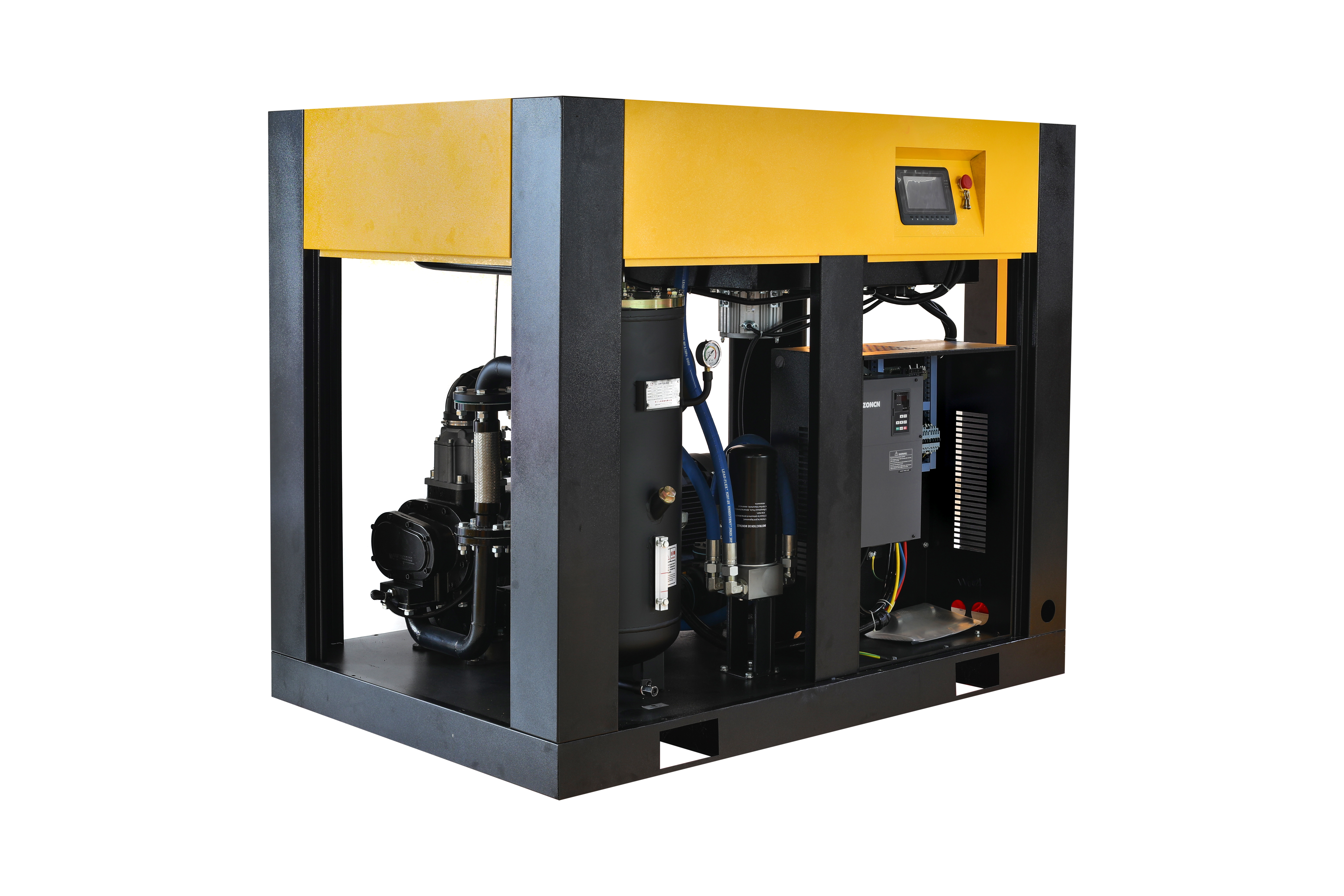
A stable airend temperature within the proper range is the first line of defense for safe operation of a compressed air system.
Many maintenance staff and purchasing customers ask the same question: what temperature does a screw compressor's airend need to reach in order to evaporate the moisture out of the compressed air?
This question itself contains a common misunderstanding. The purpose of controlling airend temperature has never been to "dry out" the water — it's to prevent water from condensing into liquid form inside the unit.
Once this is clear, it becomes easy to understand why the industry generally sets airend operating temperature at 75–85°C, and why a temperature that's too low is actually more insidious and more dangerous than one that's too high.
This article covers four things: what pressure dew point actually is, how water vapor behaves during compression, what the 75–85°C range is protecting against, and why liquid water is a fatal risk in air separation applications.
Many people assume that the higher the airend temperature, the more easily water in the compressed air gets "evaporated away," making the air drier. This understanding is only half right. Higher temperature does keep water in vapor form, but it cannot make water disappear from the compressed air. The water vapor is still in the air — it just hasn't turned into liquid droplets. Once the compressed air later cools down — passing through piping, an air receiver, or downstream treatment equipment — the water vapor will condense into water all the same.
So the real function of high airend temperature is this: during compression and oil-air separation, keep the water vapor in gas form so that liquid water doesn't precipitate out inside the airend, the oil separator tank, or the oil piping.
In other words, airend temperature control prevents "internal water accumulation," not "dry air." To actually remove moisture, you need downstream drying equipment — refrigerated dryers, desiccant dryers, and so on.
To understand the relationship between airend temperature and water vapor, you first need to understand pressure dew point.
At atmospheric pressure, water boils at 100°C — that's common knowledge. But in a compressed air system, whether water vapor will condense is determined not by 100°C, but by the dew point temperature at the current pressure.
Simply put, pressure dew point is the critical temperature at which water vapor in compressed air, at a given pressure, begins to condense into liquid water. Above the dew point, water vapor stays in gas form; below it, water vapor condenses out.
The higher the pressure, the less water vapor the air can hold, and the higher the dew point temperature becomes. This is why the dew point of compressed air is far higher than at ambient conditions — it's not that water needs 100°C to evaporate, but that under high-pressure conditions, water vapor may start condensing at just fifty or sixty degrees Celsius.
In one sentence: at atmospheric pressure, look at the boiling point; for compressed air, look at the dew point — the higher the pressure, the higher the dew point, and the more readily water comes out.
To understand why temperature control matters, it helps to follow the compressed air through the whole process.
Step 1: Intake. Ambient air is drawn into the compressor, containing a certain amount of water vapor. Air at 20°C and 60% relative humidity contains roughly 10 grams of water per cubic meter.
Step 2: Compression. Air is compressed by the screw rotors, its volume shrinks sharply, and pressure rises from atmospheric to about 0.7–0.8 MPa. During compression, temperature rises rapidly, and at the same time, the density of water vapor per unit volume of air multiplies.
Step 3: Oil-air mixing and separation. In oil-injected screw compressors, compressed air mixes with lubricating oil and enters the oil separator tank, where the oil is separated out and the air continues onward. This stage has the highest temperature, and it's also the point where preventing water vapor condensation matters most — because if condensation happens here, the water mixes directly into the lubricating oil.
Step 4: Aftercooling and delivery. After leaving the airend, compressed air passes through an aftercooler to cool down, then enters the air receiver and piping. As temperature drops, large amounts of water vapor condense — which is why the bottom of the air receiver needs to be drained every day.
The critical point is Step 3. If the airend temperature falls below the pressure dew point, water vapor will condense prematurely in the oil separator tank and oil piping, and liquid water mixes directly into the lubricating oil. This is the root cause of oil emulsification — it's not that the oil quality is poor, but that water has gotten into the unit.
(Diagram: The state changes of water vapor at different stages across the full compressed air process. In the airend and oil-separation stages, temperature stays above the dew point and water vapor remains gaseous; in the aftercooling and air-receiver stages, temperature drops and water vapor condenses and is drained.)
With pressure dew point understood, the significance of 75–85°C becomes clear.
Take the common 7–8 bar (0.7–0.8 MPa) operating condition as an example: under normal ambient intake conditions, the pressure dew point after compression is roughly 60–65°C.
This means:
The industry sets normal operating temperature at 75–85°C essentially to leave a 10–20°C safety margin above the pressure dew point. This margin absorbs fluctuations in ambient temperature, load changes, and intake humidity variation, ensuring the airend temperature doesn't drop below the dew point even when operating conditions fluctuate.
Reference values at different pressures:
| Discharge pressure | Pressure dew point (approx.) | Recommended minimum airend temp | Normal operating range |
| 0.7 MPa | 60°C | ≥70°C | 75–85°C |
| 0.8 MPa | 63°C | ≥73°C | 75–88°C |
| 1.0 MPa | 68°C | ≥78°C | 80–90°C |
Note: The above are empirical reference values for standard-temperature intake (20°C) and typical humidity conditions; actual dew point varies with the machine room environment, intake temperature, humidity, and unit model.
Misunderstanding 1: The higher the temperature, the better — higher temperature means drier air. Higher temperature only keeps water vapor in gas form; it does not reduce the amount of water vapor in the air. Moreover, once temperature exceeds 95°C, lubricating oil oxidizes and carbonizes rapidly, seals age, and the risk of bearing wear rises sharply. High temperature is not a moisture-removal method — it's a fault signal.
Misunderstanding 2: As long as airend temperature is normal, the compressed air has no water. Normal airend temperature only guarantees no condensation inside the unit. After leaving the airend, compressed air cools to around 40°C through the aftercooler, and large amounts of water vapor condense in the air receiver and piping. That's why the air receiver must be drained regularly, and downstream drying equipment must be installed.
Misunderstanding 3: A slightly lower temperature in winter doesn't matter — only summer heat needs watching. Quite the opposite. In winter, low ambient temperatures make it easier for the airend to run below 70°C for extended periods, which actually makes condensation and oil emulsification more likely. Many units develop problems in winter not because of high temperature, but because temperature can't get high enough. In winter operation, pay even closer attention to whether airend temperature stays stably above 75°C.
Going forward, there's no need to memorize complicated formulas when checking airend temperature — just follow these four steps:
Step 1: Check whether it's in the normal range. 75–85°C is normal; below 70°C or above 90°C warrants attention.
Step 2: Check the temperature trend. Is it stable at one value, or continuously creeping up? A steady rise usually means a clogged radiator or a faulty thermostatic valve; a persistently low reading usually means the thermostatic valve is stuck open, or oil is bypassing the airend entirely.
Step 3: Check the correlation with load. Temperature rising under load and dropping under unload is normal. If temperature rises rather than falls after unloading, or won't rise after loading, the thermostatic system has a problem.
Step 4: Check the oil condition. Regularly check the oil sight glass for darkening, emulsification, or foam. Oil emulsification is direct evidence of internal water intrusion, indicating the airend temperature has been running low for a long time or the thermostatic valve has failed.
Remember one core principle: temperature isn't better the higher it is, nor safer the lower it is — staying stable within the safe range above the dew point is the goal.
For air separation equipment customers, controlling compressor airend temperature isn't just about protecting the compressor itself — it's directly tied to the safety of the downstream air separation system.
The core of an air separation unit is the molecular sieve adsorber and the distillation column. Before compressed air enters the air separation unit, it must go through rigorous pre-cooling and purification to remove water and carbon dioxide down to extremely low levels.
If the compressor airend temperature runs low and liquid water precipitates inside the unit, this water travels downstream with the compressed air:
So for air separation customers, keeping compressor airend temperature stable at 75–85°C is not a negotiable operating parameter — it's the first line of defense protecting the entire downstream air separation plant.
(Diagram: In an air separation system, the main risk points for liquid water are concentrated at the compressor outlet and the molecular sieve inlet. Once liquid water enters the adsorber, it directly causes the molecular sieve to fail, threatening the operation of the entire air separation plant.)
Back to the original question: at what temperature does the airend "evaporate" moisture?
The answer is: the airend doesn't need to "evaporate" moisture at all — it only needs to keep temperature above the pressure dew point, so water vapor doesn't condense inside the unit. For a standard 7–8 bar unit, that temperature is 75–85°C.
Truly removing moisture from compressed air depends on downstream refrigerated dryers, desiccant dryers, and air receiver drainage. High airend temperature can't accomplish this, and shouldn't be expected to.
For maintenance staff, understanding the mechanism behind "what temperature" matters more than the number itself: the relationship between temperature and dew point, the correlation between load and temperature, and the linkage between oil condition and temperature. Understand these three layers, and both high- and low-temperature faults can be diagnosed quickly.
For air separation customers, a stable compressor airend temperature is the first layer of insurance for stable operation of the entire downstream plant.
 View More
 View More
 View More
 View More
 View More
 View More
 +86-576-8262 1313
 +86-576-8262 1216
 +86-13867656789
 +86-13867656789
Xiayun Village, Hengjie Town, Luqiao District, Taizhou City Zhejiang Province, China

Copyright © Zhejiang Zhilun Mechanical & Electrical Co., Ltd. All Rights Reserved.
Air Compressor Factory

 English
 русский
 Français
 Español
 Português
