High Efficiency and Energy Saving: Reducing Operational Costs Significantly
Energy efficiency is a key concern for industrial enterprises in selecting air compressors, and screw air compressors have obvious advantages in this regard. The core of their high efficiency lies in the advanced twin-screw meshing compression principle. During operation, the two mutually meshing screws rotate synchronously, forming a closed compression cavity that continuously compresses the incoming air. This compression method has high volumetric efficiency, with the thermal efficiency and mechanical efficiency far higher than those of traditional reciprocating compression equipment.
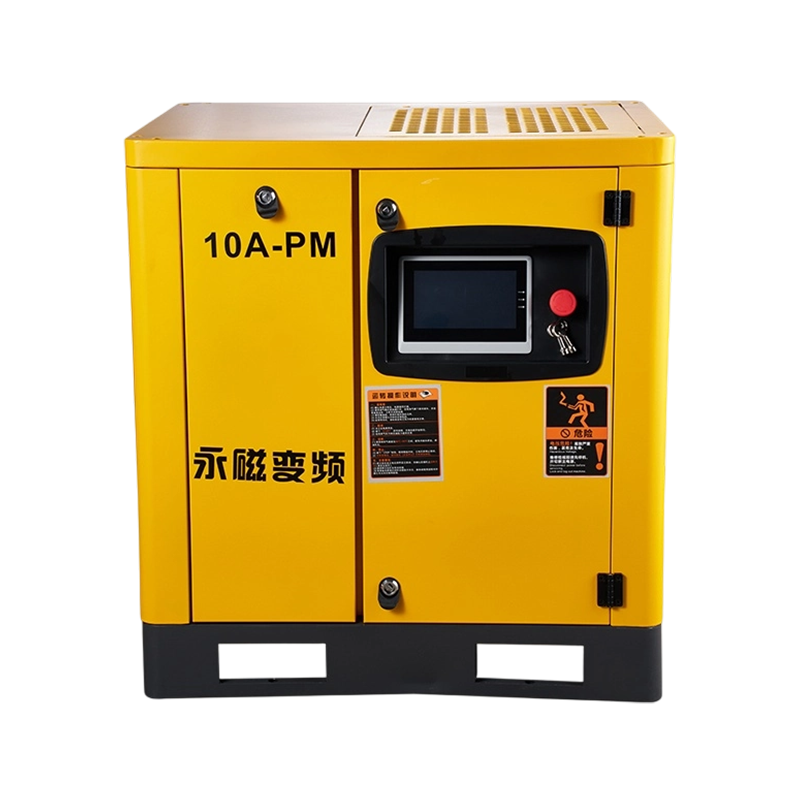
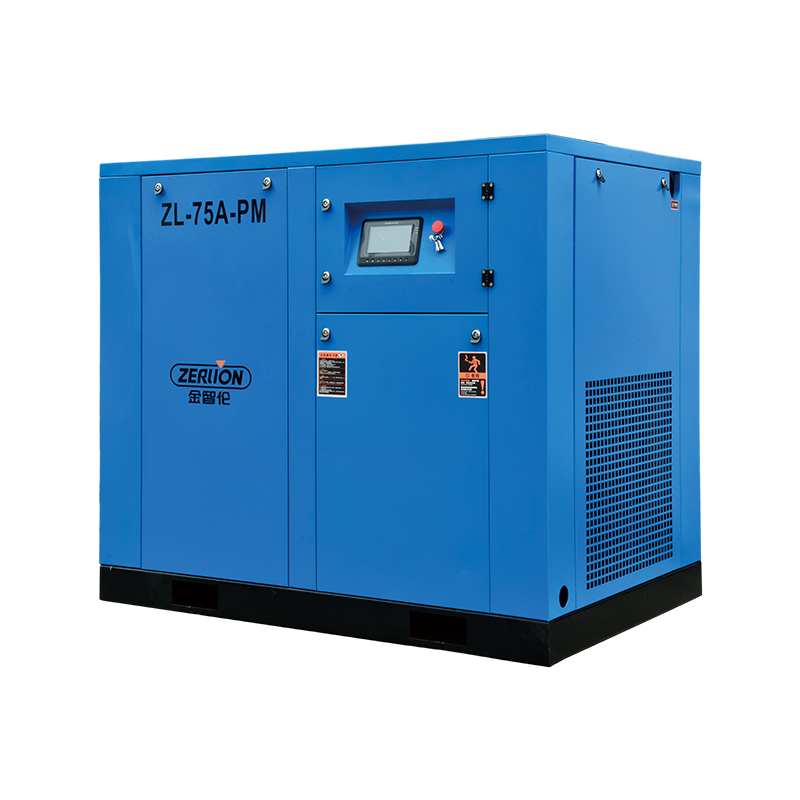
In addition, modern screw air compressors are widely equipped with permanent magnet variable frequency (PMV) technology. This technology can adjust the operating speed of the compressor in real time according to the actual air demand of the production line. When the air demand decreases, the speed decreases accordingly, avoiding the energy waste caused by the constant-speed operation of traditional fixed-speed air compressors. Taking ZERLION's ZL-150A-PM permanent magnet variable frequency screw air compressor as an example, compared with ordinary fixed-speed models, it can save energy by 20%-35%, which greatly reduces the long-term electricity cost of enterprises, a major part of the operational costs.
Stable and Continuous Operation: Guaranteeing Uninterrupted Production
Industrial production, especially large-scale continuous production lines such as automobile manufacturing and electronic component processing, has strict requirements on the continuity and stability of compressed air supply. Screw air compressors have a simple and compact structure, with fewer wearing parts compared to piston air compressors. The main components, such as the screw rotor and bearing, adopt high-precision processing technology and high-quality materials, which can realize long-term continuous operation without frequent shutdowns for maintenance.
Generally, the continuous operation time of screw air compressors can reach 8000-12000 hours, and the service life is as long as 10-15 years under proper maintenance. This stable operation performance ensures the uninterrupted supply of compressed air, avoids production interruptions caused by equipment failures, and effectively improves the overall production efficiency of enterprises. At the same time, the output pressure of screw air compressors is stable, with a pressure fluctuation range of only ±0.01MPa, which can meet the high-precision air supply requirements of precision manufacturing and other fields.
Low Noise and Low Vibration: Optimizing the Production Environment
The noise and vibration generated by equipment operation are important factors affecting the industrial production environment and employee health. Screw air compressors have obvious advantages in low noise and low vibration due to their structural characteristics. During the meshing rotation of the twin screws, the force is uniform, and there is no impact phenomenon like the reciprocating motion of piston air compressors, which fundamentally reduces the generation of vibration and noise.
Most of the mainstream screw air compressors on the market are equipped with integrated sound insulation covers and shock absorption bases. The sound insulation cover can effectively isolate the noise generated during operation, and the shock absorption base can reduce the transmission of vibration to the ground. The noise level of ordinary screw air compressors is between 65-75 decibels, which is far lower than the 85-95 decibels of traditional piston air compressors. This low-noise and low-vibration advantage makes screw air compressors suitable for use in workshops with high environmental requirements, such as electronic factories and precision machining workshops, helping enterprises create a more comfortable and safe production environment.
Wide Adaptability: Meeting Diversified Industrial Demands
Industrial production involves a variety of fields and working conditions, and the requirements for compressed air are also diversified. Screw air compressors have strong adaptability and can be customized and adjusted according to different industrial needs, covering a wide range of air volume and pressure levels.
In terms of power range, screw air compressors can be designed from small 5HP models to large 200HP+ models, which can meet the air supply needs of small and medium-sized workshops and large-scale industrial parks. In terms of special working conditions, they can be adapted to high-temperature, high-altitude, and humid environments through technical improvements. For example, in high-temperature areas such as tropical industrial zones, screw air compressors with enhanced heat dissipation systems can ensure stable operation; in the chemical industry with corrosive gases, models with anti-corrosion coatings on the rotor surface can be selected. In addition, screw air compressors can also be matched with air drying and purification systems to provide oil-free, dust-free, high-purity compressed air, meeting the strict requirements of industries such as food, medicine, and electronics for air quality.
Simple Maintenance and Low Later Costs
For industrial enterprises, the later maintenance cost and difficulty of equipment are important factors affecting the total cost of ownership. Screw air compressors have the characteristics of simple structure and few wearing parts, which greatly reduces the difficulty and frequency of maintenance.
The regular maintenance of screw air compressors mainly includes replacing the air filter, oil filter, and lubricating oil, which can be completed quickly by professional maintenance personnel without disassembling the main engine. Compared with piston air compressors that need to frequently replace piston rings, valve seats, and other parts, the maintenance cycle of screw air compressors is longer (usually 2000-4000 hours), and the maintenance cost is 30%-50% lower. In addition, many modern screw air compressors are equipped with intelligent monitoring systems, which can real-time monitor the operating status of the equipment, predict potential faults in advance, and remind maintenance personnel to handle them in time, avoiding major faults caused by untimely maintenance and further reducing the later operation and maintenance costs.

 View More
 View More
 View More
 View More
 View More
 View More
 +86-576-8262 1313
  +86-576-8262 1216
  +86-13867656789
  +86-13867656789

 English
 русский
 Français
 Español
 Português
